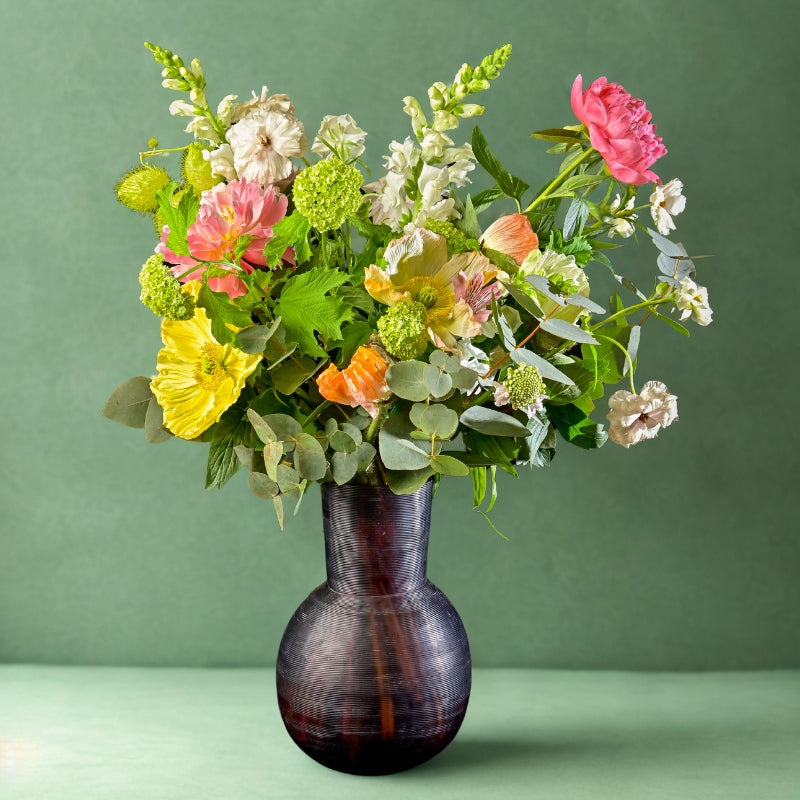

Ikebana is an ancient Japanese art that unites nature and spirituality through meticulous and symbolic arrangements. At Iki de Veyrac, we invite you to discover the origins, styles, and philosophy behind this fascinating practice.
The Historical Roots of Ikebana
Ikebana originated in the 7th century, when Japanese ambassadors brought Chinese floral art to Japan, seamlessly blending it with Buddhism. Initially practiced by monks in a style called "rikka," the art became popular among aristocrats before evolving into a recognized aesthetic discipline. In the 15th and 16th centuries, Ikebana developed further, codifying techniques into different schools, creating elaborate Japanese flower arrangements reserved for the alcoves of Japanese homes. Since the 1920s, Ikebana has continued to evolve, with new schools adopting their own rules, such as "nageire," for natural simplicity, and "moribana," offering a modern take on flower arrangement.
Philosophy of Ikebana
The essence of Ikebana lies in the harmony between man and nature. Each arrangement seeks to capture the ephemeral beauty of natural elements while reflecting deep emotions. The representation of Earth, Man, and Heaven forms the heart of each Japanese floral arrangement. Unlike Western arrangements that emphasize floral abundance, Ikebana values quality over quantity, emphasizing delicacy, minimalism, and graphic design. This process invites meditation and mindfulness in the present moment.
Main schools of Ikebana
At Iki de Veyrac, we respect and integrate the teachings of the main schools of Ikebana:
- The Ikenobo school : The oldest, it perpetuates a thousand-year-old tradition dating back to the monk Senmu, promoting religious and abstract principles.
- The Ohara school : Emerging in the 19th century, it introduced "Moribana" for freer creations adapted to modern tastes.
- The Sogetsu School : Founded in the 20th century, it advocates a creative approach where individual artistic expression takes precedence, without strict rules.
Contemporary practice of Ikebana
Despite their massive urbanization, the Japanese remain deeply attached to nature, and Ikebana finds its place in contemporary urban homes, bringing serenity and nature to these often confined spaces. This art is not limited to aesthetic aspects; it also embodies a way of life. As in the tea ceremony, practicing Ikebana requires silence and concentration, allowing a deep connection with the present moment. At Iki de Veyrac, we use seasonal natural materials, favoring simplicity and elegance in the staging of each Japanese floral arrangement.
The Future of Ikebana with IKI de Veyrac
With its many schools and stylistic evolutions, Ikebana continues to influence and inspire artists and enthusiasts alike. This tradition remains vibrant thanks to its constant adaptation to modern sensibilities while respecting its ancestral roots. Increasingly popular abroad, Ikebana is the subject of exhibitions, classes, and conferences around the world, highlighting this unique form of Japanese flower arranging. Many enthusiasts are discovering the meditative and aesthetic benefits of this refined practice.
In conclusion, Ikebana transcends simple Japanese floral arrangement, becoming a true celebration of nature and meditation. This art harmoniously integrates Japanese aesthetics and philosophy into our modern daily lives. Whether you're a novice or an expert, each creation by Iki de Veyrac offers you a renewed perspective on the ephemeral beauty of life.